Vlassis Caniaris (1928–2011) is regarded as one of the most important pioneers of Greek post-war art. He was interested in how works of art can serve as testimonies to social conditions. Starting out in representational painting, he persistently developed his own approaches to reality as an artist and gained international recognition.
In 1975, some of his works were already on display at the Kunstmuseum Bochum in the exhibition ‘Gastarbeiter — Fremdarbeiter’ (Guest Worker — Foreign Worker). Due to a DAAD scholarship for international artists, Caniaris had been exploring the living conditions of recruited migrant workers in Berlin since 1973. He sought an empathetic understanding how labour, migration and alienation impacted people. Caniaris explained that his aim was not to create an activist exhibition. He intended, as he himself put it, to reveal ‘the problems behind the surface’, whilst also allowing contradictions to remain and paying attention to the dreams inherent in every real-life situation. At the same time, the title ‘Gastarbeiter – Fremdarbeiter’ places the reality of the 1970s within a sustainability of the Nazi system, in which civilian forced labour was colloquially referred to as ‘Fremdarbeit’ (foreign work).
When a visitor was asked in 1975 whether the exhibition ‘accurately represented him as a guest worker’, he invented the name ‘Grentzelos’ for himself in a newspaper interview and refused to be clearly categorised. Similiarly Caniaris’ work resists simple political appropriation to this day. Its relevance is evident in a persistent openness that prompts us to reflect on our own perception. Grentzelos is a found name. Vlassis Caniaris, too, worked with found materials that not only bear traces of reality but remain rooted in it. He observed closely, collected everyday objects and scenes, and constructed images, environments and assemblages: enigmatic works and motifs that are almost documentary.
The exhibition Grentzelos brings images, objects, figures and environments created between the 1950s and the 1980s together. They illustrate the artistic precision and stubbornness of Caniaris, who worked towards a dissolution of the classical concept of the image and grappled with questions of realism and scenography.
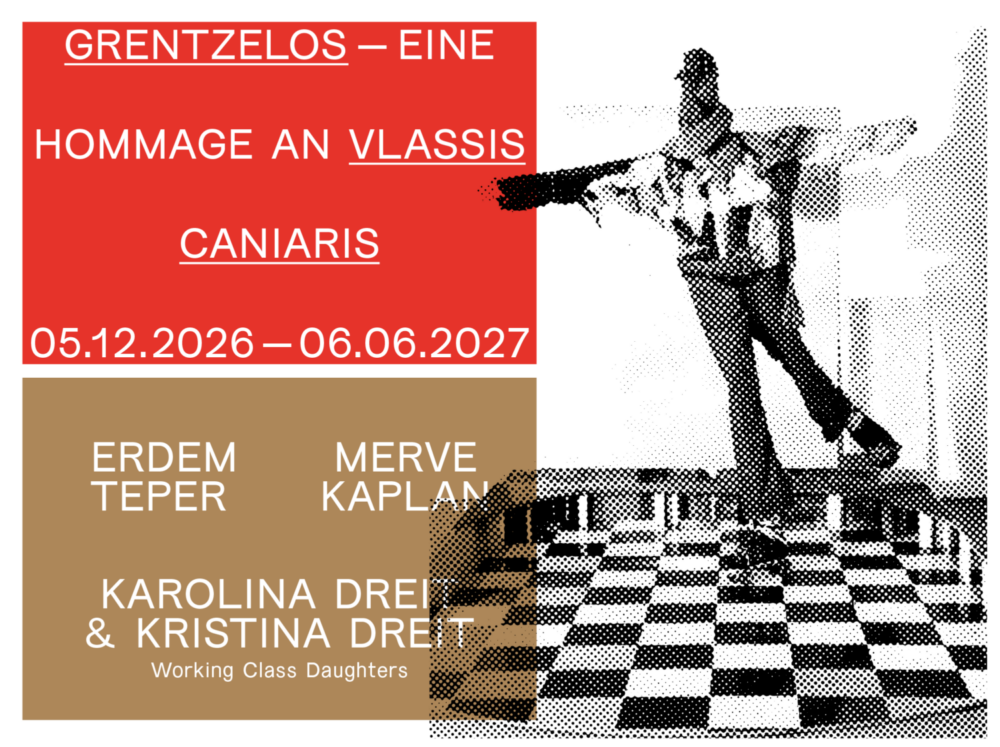
A tribute is usually paid by later generations: contemporary works by Karolina Dreit and Kristina Dreit, Merve Kaplan and erdem teper expand the exhibition to include today’s perspectives. The artists look from the present at the multi-layered work of Vlassis Caniaris and the associated themes of labour, migration and alienation. In doing so, Caniaris’s figures—now steeped in history—become observers of our own time.